

BASAL CELL CARCINOMA (BCC)
Overview
Basal cell carcinoma (BCC) is the most common form of skin cancer. It arises from basal cells in the epidermis and most often develops on areas of skin that receive chronic sun exposure, including the face, scalp, ears, neck, and upper trunk.
BCC occurs more frequently in individuals with fair skin (Fitzpatrick skin types I and II), but it can affect people of all skin types. It is typically slow-growing and rarely spreads to distant organs. However, if left untreated, basal cell carcinoma can become locally invasive and cause significant tissue damage and disfigurement.
Early evaluation and treatment are important to prevent progression.
Common Signs and Appearance
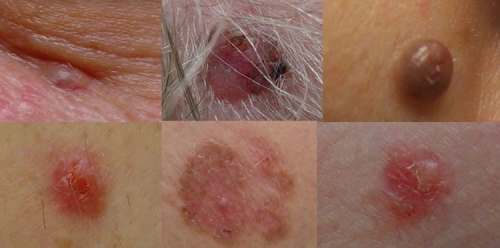
Basal cell carcinoma can appear in several forms, and its appearance may vary depending on subtype and location. Common features include:
- A slowly enlarging skin lesion or sore that does not heal
- A raised or irritated area that may bleed, crust, or scab repeatedly
- A shiny, pearly, or translucent bump (nodular BCC)
- A flat, scar-like or pink patch with poorly defined borders
- Mild itching or irritation
Basal cell carcinoma is often painless, which can delay evaluation.

Risk Factors
Factors that may increase the risk of basal cell carcinoma include:
- Chronic or intense sun exposure
- History of sunburns
- Fair skin, light hair, or light eyes
- Increasing age
- Personal or family history of skin cancer
- Use of tanning beds
Diagnosis
A suspicious skin lesion cannot be definitively diagnosed by visual examination alone. Diagnosis of basal cell carcinoma requires biopsy.
Depending on the lesion’s characteristics, diagnosis may involve:
- Shave biopsy
- Punch biopsy
- Complete surgical excision
The tissue sample is examined by a dermatopathologist, who provides a detailed pathology report confirming the diagnosis and tumor characteristics.
Treatment Options
Surgical removal is the most commonly recommended treatment for basal cell carcinoma. The primary goals of treatment are:
- Complete removal of malignant tissue
- Prevention of local invasion or recurrence
- Preservation of function and cosmetic appearance
Treatment selection depends on lesion size, depth, location, and pathology findings. Options may include:
- Surgical excision
- Laser-assisted removal for selected lesions
- Topical therapy (in specific, limited cases)
- Photodynamic therapy or radiation therapy for select patients
Some lesions may require additional excision to ensure clear margins, depending on pathology results.
Prognosis
When detected early and treated appropriately, basal cell carcinoma has an excellent prognosis. Regular skin examinations and prompt evaluation of new or changing lesions help reduce the risk of complications.
When to Seek Evaluation
You should consider a professional skin evaluation if you notice:
- A lesion that bleeds or scabs repeatedly
- A sore that does not heal
- A slowly growing bump or patch
- A skin lesion with changing appearance
Discuss Skin Cancer Evaluation and Treatment
Basal cell carcinoma requires medical evaluation to determine appropriate treatment.
📞 Call (847) 518-9999 to schedule a dermatology evaluation.
Medical Disclaimer
The information on this page is provided for educational purposes only
and does not replace professional medical evaluation, diagnosis, or treatment.
Individual findings and treatment recommendations vary and require physician
assessment.
Learn More About